Literary Fiction

All countries Afghanistan Algeria Antigua and Barbuda Argentina Australia Austria Azerbaijan Bangladesh Barbados Belgium Benin Bosnia and Herzegovina Brazil Bulgaria Burkina Faso Burundi Cabo Verde Canada Central African Republic Chile China Colombia Congo, Democratic Republic Costa Rica Côte d’Ivoire (Ivory Coast) Croatia Cyprus Czech Republic Denmark Dominica Dominican Republic Egypt El Salvador Estonia Ethiopia France Germany Ghana Greece Hungary Iceland India Iran Iraq Ireland Italy Jamaica Japan Jordan Kazakhstan Kenya Kuwait Latvia Lebanon Libya Lithuania Madagascar Mexico Moldova Morocco Myanmar Netherlands New Zealand Nigeria North Korea North Macedonia Norway Oman Pakistan Palestine Philippines Poland Portugal Puerto Rico Russia Rwanda Saint Kitts and Nevis Saudi Arabia Senegal Singapore South Korea Spain Sri Lanka Sudan Sweden Switzerland Syria Taiwan Tanzania Thailand Türkiye Uganda United Arab Emirates United Kingdom United States Uzbekistan Vietnam Zambia
Newest first Oldest first
1
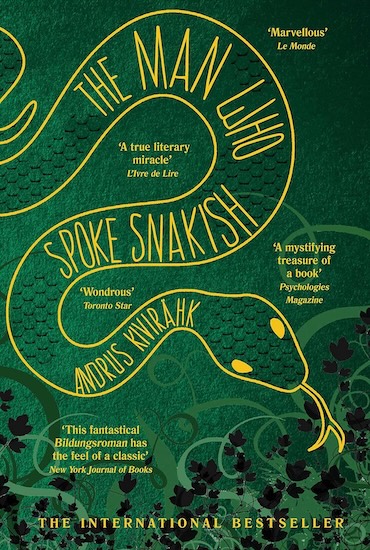
The Man Who Spoke Snakish
Andrus Kivirähk
Set in a fantastical version of medieval Estonia, The Man Who Spoke Snakish follows Leemet, a boy growing up in the forest among the last people who preserve an ancient way of life. His people speak Snakish, a magical language that allows them to communicate with snakes and command animals. For generations, they have lived in close connection with nature, hunting for food and worshipping their ancestral spirits. But the forest is gradually emptying. More and more people abandon their traditional lives to settle in villages, embrace Christianity, and adopt the customs introduced by foreign conquerors. As the old language and its knowledge disappear, Leemet finds himself caught between a vanishing world and a new society that regards his people’s traditions as backward and obsolete. Combining dark humour, folklore, absurdity, and fantasy, Kivirähk creates an allegory about cultural assimilation and the loss of collective identity. The novel explores how conquest transforms not only political structures but also languages, relationships with nature, and people’s understanding of themselves. Through Leemet’s struggle to preserve his heritage, it asks what happens when an entire culture is dismissed as primitive—and whether traditions can survive when even their own people begin to abandon them.
Estonia 2007