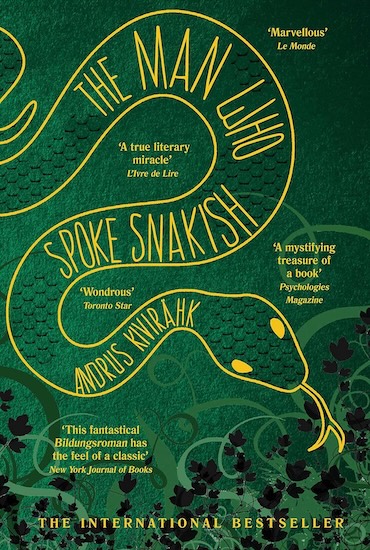
The Man Who Spoke Snakish
Summary
Set in a fantastical version of medieval Estonia, The Man Who Spoke Snakish follows Leemet, a boy growing up in the forest among the last people who preserve an ancient way of life. His people speak Snakish, a magical language that allows them to communicate with snakes and command animals. For generations, they have lived in close connection with nature, hunting for food and worshipping their ancestral spirits.
But the forest is gradually emptying. More and more people abandon their traditional lives to settle in villages, embrace Christianity, and adopt the customs introduced by foreign conquerors. As the old language and its knowledge disappear, Leemet finds himself caught between a vanishing world and a new society that regards his people’s traditions as backward and obsolete.
Combining dark humour, folklore, absurdity, and fantasy, Kivirähk creates an allegory about cultural assimilation and the loss of collective identity. The novel explores how conquest transforms not only political structures but also languages, relationships with nature, and people’s understanding of themselves. Through Leemet’s struggle to preserve his heritage, it asks what happens when an entire culture is dismissed as primitive—and whether traditions can survive when even their own people begin to abandon them.
Reviews
Login to leave a review.
No reviews yet. Be the first!

- Published
- 2007
- Author
- Andrus Kivirähk