Classics
All countries
Antigua and Barbuda
Argentina
Armenia
Australia
Austria
Azerbaijan
Bangladesh
Barbados
Belgium
Bosnia and Herzegovina
Brazil
Chile
China
Colombia
Czech Republic
Denmark
Dominica
Dominican Republic
Egypt
Finland
France
Germany
Greece
Hungary
Iceland
India
Indonesia
Iran
Ireland
Italy
Japan
Kenya
Kyrgyzstan
Lebanon
Lithuania
Mexico
Netherlands
Norway
Pakistan
Palestine
Peru
Portugal
Romania
Russia
Saudi Arabia
Spain
Sudan
Sweden
Switzerland
Taiwan
Türkiye
Ukraine
United Kingdom
United States
1

Jamila
Set in a Kyrgyz village during the Second World War, Jamila tells the story of a young woman whose husband is away serving at the front. Jamila lives with her husband’s family and helps transport grain alongside her teenage brother-in-law, Seit, who narrates the story. Their daily journeys bring them into contact with Daniyar, a quiet, solitary soldier whose deep love of music gradually reveals a sensitive inner world.
As Seit observes the growing connection between Jamila and Daniyar, he begins to understand that love cannot always be contained by social expectations or family obligations. Their relationship challenges the conventions of rural life, where duty and reputation often take precedence over individual happiness. Through vivid descriptions of the Kyrgyz landscape and the rhythms of village life, Aitmatov explores emotional freedom, artistic expression, and the courage required to choose one’s own path. The novella is also a coming-of-age story for Seit, whose discovery of love and beauty transforms his understanding of the world.
Kyrgyzstan
1960
2
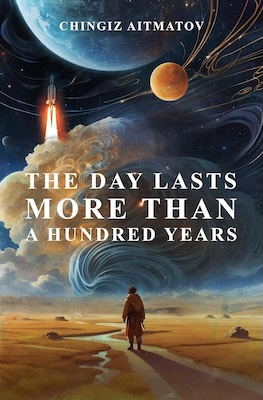
The Day Lasts More than a Hundred Years
Set in the vast Central Asian steppe, The Day Lasts More Than a Hundred Years begins with the death of Kazangap, a railway worker whose longtime friend, Edigei, undertakes to carry him to his ancestral burial ground. During the journey, Edigei remembers their lives together and the transformations that have reshaped their community under Soviet rule. Their destination, however, is blocked by a restricted military zone, turning a simple act of mourning into a confrontation with a world increasingly governed by impersonal authority.
As the narrative unfolds, Aitmatov interweaves the characters’ memories with Kazakh legends, reflections on cultural heritage, and a science-fiction storyline involving contact with an extraterrestrial civilization. These seemingly distant narratives converge around questions of memory, humanity, and the dangers of forgetting one’s past.
The novel examines how political power, technological ambition, and ideological conformity can erode cultural identity and human dignity. Drawing on the oral traditions of the steppe while imagining humanity’s future among the stars, Aitmatov creates an ambitious meditation on what it means to remain human in a rapidly changing world.
Kyrgyzstan
1983