The Day Lasts More than a Hundred Years
Kyrgyzstan

The Day Lasts More than a Hundred Years

by Chingiz Aitmatov

Summary

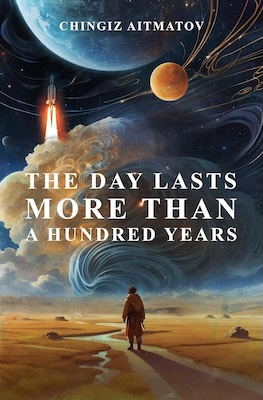
Set in the vast Central Asian steppe, The Day Lasts More Than a Hundred Years begins with the death of Kazangap, a railway worker whose longtime friend, Edigei, undertakes to carry him to his ancestral burial ground. During the journey, Edigei remembers their lives together and the transformations that have reshaped their community under Soviet rule. Their destination, however, is blocked by a restricted military zone, turning a simple act of mourning into a confrontation with a world increasingly governed by impersonal authority.

As the narrative unfolds, Aitmatov interweaves the characters’ memories with Kazakh legends, reflections on cultural heritage, and a science-fiction storyline involving contact with an extraterrestrial civilization. These seemingly distant narratives converge around questions of memory, humanity, and the dangers of forgetting one’s past.

The novel examines how political power, technological ambition, and ideological conformity can erode cultural identity and human dignity. Drawing on the oral traditions of the steppe while imagining humanity’s future among the stars, Aitmatov creates an ambitious meditation on what it means to remain human in a rapidly changing world.

Reviews

Login to leave a review.

No reviews yet. Be the first!

You might also like

Chingiz Aitmatov
Chingiz Aitmatov

Chingiz Aitmatov (1928–2008) was a celebrated Kyrgyz novelist, short-story writer, and diplomat whose work brought the literature and cultural traditions of Central Asia to an international audience. Born in Sheker, a village in what was then the Kyrgyz Soviet Socialist Republic, he grew up during a turbulent period in Soviet history. His father, a government official, was arrested and executed during Stalin’s purges in 1938, an experience that profoundly influenced Aitmatov’s understanding of political repression and human suffering. Aitmatov initially studied agriculture before pursuing a literary career. He gained international recognition with Jamila (1958), a novella often praised for its lyrical portrayal of love and personal freedom. Other major works include The First Teacher (1962), Farewell, Gulsary! (1966), The White Ship (1970), and The Day Lasts More Than a Hundred Years (1980). His writing blends Kyrgyz folklore, oral storytelling, and nomadic traditions with universal questions about morality, memory, nature, and the consequences of political power. Beyond literature, Aitmatov served as a diplomat and represented Kyrgyzstan and the Soviet Union in international cultural and political contexts. His works have been translated into numerous languages, and he remains one of the most influential literary figures to emerge from Central Asia.

View author page
Published
1983
Author
Chingiz Aitmatov