Books from Türkiye
Suggest a book
All genres
Historical Fiction
Literary Fiction
Fantasy
Romance
Horror
Thriller
Non-Fiction
Mystery
Memoir
Classics
History
Sci-Fi
Contemporary Fiction
Science Fiction
Fiction
Poetry
Essays
Family Saga
Magical Realism
Family Drama
Dark Academia
Psychological Fiction
Dark Comedy
Political Writing
Feminist Fiction
Satire
Campus Fiction
Cultural Studies
Biography
Philosophy
Comedy
Drama
Young Adult
Gothic
Dystopia
Crime
Children's Books
Short Stories
Mythology
Cozy
Retellings
Humour
Adventure
All themes
Love & Passion
Adventure & Journey
Identity & Belonging
War & Conflict
Freedom & Resistance
Family & Heritage
Nature & Landscape
Society & Class
Spirituality & Faith
Solitude & Exile
Coming of Age
Revolution & Change
Friendship
History
Immigration
Myths and Retellings
Colonialism
Women & Society
Mental Health
Motherhood
1
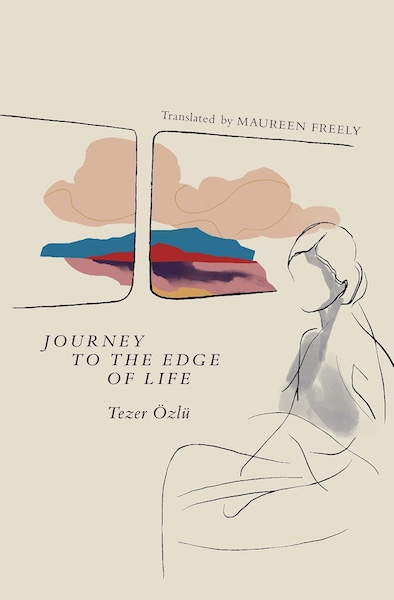
Journey to the Edge of Life
An unnamed Turkish writer embarks on a restless journey across Europe, following the lives and deaths of three writers who have profoundly shaped her imagination: Cesare Pavese, Franz Kafka, and Italo Svevo. Travelling through Berlin, Prague, Vienna, Zagreb, and other cities, she seeks out the places where they lived, wrote, and died, hoping to understand the connection between literature, suffering, and the desire to live.
But this is no ordinary literary pilgrimage. Moving between memories, encounters with lovers, and reflections on her own troubled past, the narrator questions marriage, sexuality, political repression, and the expectations society imposes on women. Her travels become an attempt to escape the confines of her former life and discover a freedom that has always seemed just beyond reach.
Blurring the boundaries between autobiography, travel writing, and fiction, Journey to the Edge of Life is an intense meditation on loneliness, mortality, and the search for meaning. Tezer Özlü transforms the European landscape into a map of her inner world, revealing how the lives of writers we admire can become inseparable from our own search for identity and freedom.
2025
2
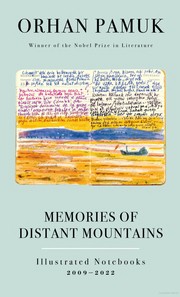
Memories of Distant Mountains
Memories of Distant Mountains is a collection of illustrated notebooks and personal reflections by Nobel Prize-winning author Orhan Pamuk, offering an intimate glimpse into his creative and everyday life. Combining handwritten notes, sketches, paintings, and observations, Pamuk moves between memories of his childhood in Istanbul, reflections on his family, and thoughts about the places, people, and experiences that have shaped his imagination.
The book reveals the relationship between writing and visual art in Pamuk’s creative process, showing how drawings and brief observations can capture moments that conventional storytelling might overlook. His notebooks also explore solitude, memory, urban life, and the passage of time, often returning to Istanbul as both a physical place and an enduring source of inspiration. Blending autobiography, travel writing, and artistic meditation, the collection offers readers access to the private world behind Pamuk’s novels. It is a reflection on how creativity emerges from paying attention to ordinary experiences and transforming fleeting impressions into lasting forms of expression.
2022
3
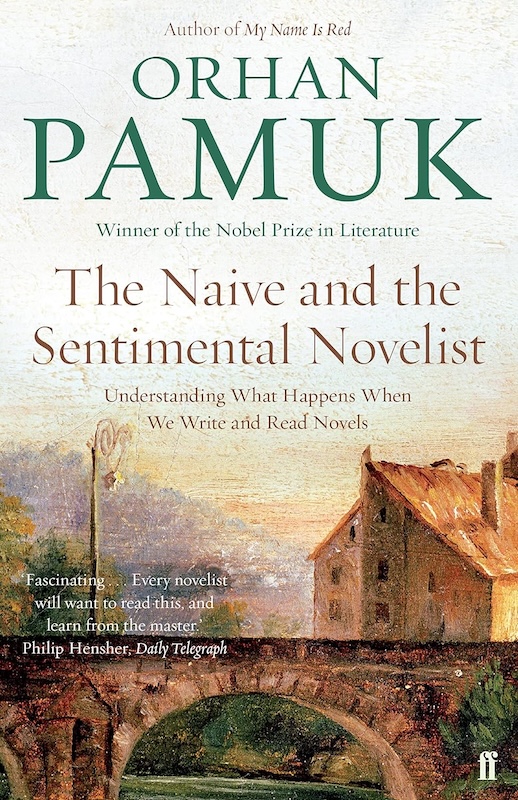
The Naive and the Sentimental Novelist
The Naive and the Sentimental Novelist explores how novels work and why reading fiction can transform our understanding of ourselves and the world. Drawing on his experience as a novelist and his lifelong engagement with literature, Orhan Pamuk examines the relationship between writers, readers, and the fictional worlds they create. Inspired by Friedrich Schiller’s distinction between naive and sentimental poetry, Pamuk considers two approaches to storytelling: one that emerges naturally from experience and another that consciously reflects on its own methods and meanings.
Through examples from writers such as Tolstoy, Dostoevsky, and Thomas Mann, Pamuk discusses character, plot, setting, symbolism, and the delicate balance between imagination and observation. He also explores the pleasure readers find in entering a novel’s world, visualising its landscapes, and identifying with its characters. Blending literary criticism with personal reflection, the book offers an intimate account of the novelist’s craft and the reader’s experience. Ultimately, Pamuk suggests that the power of fiction lies in its ability to make imagined worlds feel as vivid and meaningful as reality itself.
2010
4
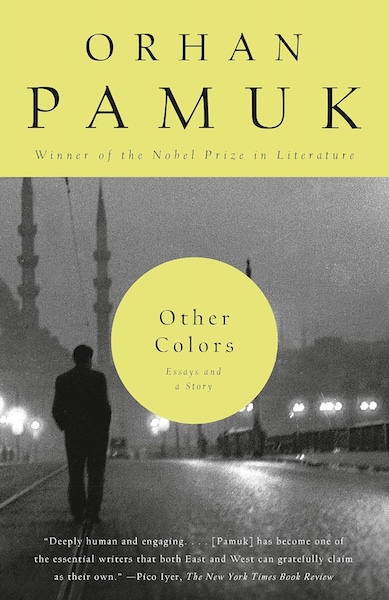
Other Colors: Essays and a Story
What does it mean to be a writer, to belong to a city, or to live between different cultural worlds? In Other Colors, Orhan Pamuk opens a window into his creative life through a collection of essays, interviews, diary entries, literary reflections, and personal recollections written over more than two decades.
Pamuk writes about his childhood in Istanbul, the pleasures and anxieties of everyday life, his relationship with his daughter, and the books and writers who shaped his imagination. He reflects on the art of writing novels, the relationship between Eastern and Western literary traditions, and the political and cultural tensions that have influenced modern Turkey. The collection also includes the short story Looking Out the Window, offering a glimpse of his fiction through a different lens.
Intimate, curious, and often provocative, Other Colors reveals the ideas and experiences behind Pamuk’s celebrated novels. It is both a portrait of a writer at work and a meditation on literature, memory, politics, and the complexities of belonging.
1999