Books from China
Suggest a book
All genres
Historical Fiction
Literary Fiction
Fantasy
Romance
Horror
Thriller
Non-Fiction
Mystery
Memoir
Classics
History
Sci-Fi
Contemporary Fiction
Science Fiction
Fiction
Poetry
Essays
Family Saga
Magical Realism
Family Drama
Dark Academia
Psychological Fiction
Dark Comedy
Political Writing
Feminist Fiction
Satire
Campus Fiction
Cultural Studies
Biography
Philosophy
Comedy
Drama
Young Adult
Gothic
Dystopia
Crime
Children's Books
Short Stories
Mythology
Cozy
Retellings
Humour
Adventure
All themes
Love & Passion
Adventure & Journey
Identity & Belonging
War & Conflict
Freedom & Resistance
Family & Heritage
Nature & Landscape
Society & Class
Spirituality & Faith
Solitude & Exile
Coming of Age
Revolution & Change
Friendship
History
Immigration
Myths and Retellings
Colonialism
Women & Society
Mental Health
Motherhood
1
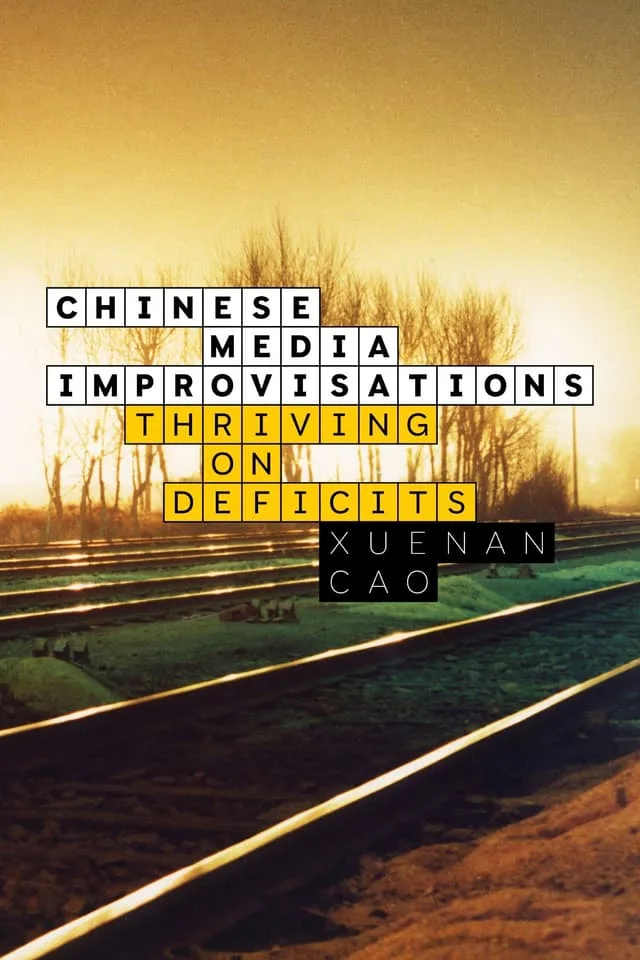
Chinese Media Improvisations
How does a society innovate when resources are scarce? In Chinese Media Improvisations: Thriving on Deficits, scholar Xuenan Cao offers a fresh perspective on China’s technological development, examining how shortages, political pressures, and material constraints have shaped the country’s media and technological imagination. Moving across several periods of Chinese history, Cao explores the printing shortages of Mao’s Great Leap Forward, the challenges of modernising China’s railway infrastructure, early experiments in information theory when computers were unavailable, and contemporary attempts to incorporate artificial intelligence into urban life. These seemingly disparate episodes reveal a recurring pattern: people adapt existing tools, improvise unconventional solutions, and transform limitations into opportunities for experimentation. Drawing on archival documents, newspapers, scientific publications, and literary works, Cao combines historical research with media theory to challenge assumptions about technological progress that originate in Western scholarship. The result is an interdisciplinary study of creativity, scarcity, and innovation that illuminates how China’s distinctive historical and political circumstances have shaped its relationship with technology.
2026
2

Nothing to My Name
Nothing to My Name is a multigenerational family saga following three Chinese women whose lives are shaped by political upheaval, social expectations, and the enduring bonds between mothers and daughters. Inspired by the author’s family history, the novel spans four decades of modern Chinese history, from the Communist Revolution to the aftermath of the 1989 Tiananmen Square protests.
In 1948, twelve-year-old Ah Xue grows up in a small fishing village in Zhoushan, where her mother earns a modest living combing the hair of wealthy women. As the civil war approaches, their already precarious existence becomes increasingly uncertain. Her daughter, Mimosa, later comes of age during the Cultural Revolution, when political tensions threaten to tear her family apart. In the next generation, Fei struggles with questions of gender identity under the influence of her activist father, whose expectations are shaped by China’s turbulent recent history.
Through these intertwined stories, Kovacs explores the lasting effects of trauma, the sacrifices women make to protect their families, and the ways history echoes across generations. The novel is a portrait of resilience, identity, and the complicated love that binds families together despite profound change.
2026
3

Winter of the Bride
Two brides, a century apart, are bound to the same powerful Chinese family—and a haunting legacy neither can escape. In 1806, Jiayi, a servant chosen as the heir’s “little wife,” discovers that her marriage offers little protection from her husband’s scheming relatives. A hundred years later, Scarlet, a midwife determined to bring modern medicine to a remote village, arrives at the family estate after marrying into it. But whispers of a curse and the ghost of a former bride begin to blur the boundary between past and present. A haunting tale of love, tradition, and the secrets that bind generations of women.
2027