Vatican City
Europe
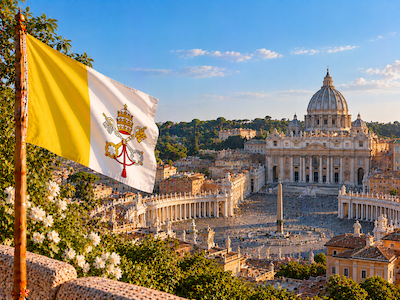
Vatican City is the world’s smallest independent state, located within Rome, Italy. Covering less than half a square kilometer, it serves as the spiritual and administrative center of the Roman Catholic Church and the residence of the Pope. At its heart lies St. Peter’s Basilica, one of the most significant religious buildings in the world, overlooking the grand St. Peter’s Square, designed by Gian Lorenzo Bernini. The Vatican Museums house an extraordinary collection of art and historical treasures, including the Sistine Chapel, whose ceiling was painted by Michelangelo. Beyond its religious importance, Vatican City preserves centuries of European art, architecture, scholarship, and cultural heritage. Latin and Italian are central to its institutional life, while the Holy See maintains diplomatic relations with countries around the world.
The literary heritage of Vatican City is closely connected to the history of the Catholic Church, classical scholarship, Christian theology, and the preservation of European manuscripts. For centuries, the Vatican Library has safeguarded rare books, ancient manuscripts, maps, and historical documents that have shaped the study of religion, philosophy, literature, and science. Latin has played a particularly important role in religious writing, theological debate, and the transmission of classical knowledge. The Vatican’s literary legacy is therefore less associated with a national tradition of fiction and poetry than with its role as a major center of scholarship, religious thought, and textual preservation. Several influential writers and thinkers are closely associated with this intellectual tradition. Saint Augustine of Hippo, whose Confessions explores faith, memory, and the search for truth, profoundly influenced Christian philosophy and Western literature. Saint Jerome translated the Bible into Latin in the version known as the Vulgate, shaping religious writing for centuries. Thomas Aquinas, whose Summa Theologica became a foundational work of Christian philosophy, explored the relationship between faith and reason. Dante Alighieri, although not a Vatican resident, drew extensively on medieval Christian theology in The Divine Comedy, one of the defining works of Italian literature. Pope John Paul II, a prolific writer and philosopher, contributed works on ethics, spirituality, and human dignity. Together, these figures illustrate the enduring influence of the Vatican’s religious and intellectual traditions on world literature and Western thought.