Uruguay
South America
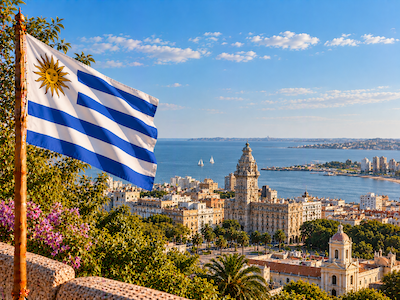
Uruguay is a small country on the southeastern coast of South America, bordered by Brazil and Argentina and facing the Atlantic Ocean. Known for its rolling grasslands, golden beaches, fertile farmland, and gentle river landscapes, Uruguay has a strong connection to nature and rural traditions. Its capital, Montevideo, sits along the Río de la Plata and combines historic architecture, lively markets, seaside promenades, and a vibrant cultural scene. Beyond the capital, Colonia del Sacramento preserves cobbled streets and colonial buildings, while the countryside is shaped by cattle ranching and the traditions of the gaucho, the South American horseman. Uruguayan culture reflects Indigenous heritage, Spanish and Portuguese influences, and waves of European immigration. Spanish is the official language, and traditions such as mate drinking, tango, and candombe music remain important parts of national life.
Uruguayan literature has made a distinctive contribution to Latin American writing, particularly through poetry, short stories, and psychologically rich fiction. Writers have explored identity, memory, political repression, exile, urban life, and the contrasts between rural traditions and modern society. The country’s literary culture has also been shaped by periods of dictatorship and censorship, which led many authors to examine freedom, justice, and the consequences of authoritarianism. Among Uruguay’s most influential writers is José Enrique Rodó, whose essay Ariel became an important work of Latin American intellectual thought, reflecting on cultural identity and the values of society. Horacio Quiroga, celebrated for his short stories, often set his tales in the forests and remote landscapes of the wider Río de la Plata region, exploring human vulnerability and the power of nature. Juan Carlos Onetti, author of The Shipyard and A Brief Life, created dark, introspective fictional worlds shaped by disillusionment and existential uncertainty. Mario Benedetti, one of Uruguay’s best-loved writers, explored love, everyday life, political commitment, and exile in works such as The Truce. Cristina Peri Rossi, a poet and novelist who lived in exile during Uruguay’s dictatorship, has written about desire, displacement, identity, and freedom. Together, these authors reveal the range of Uruguay’s literary imagination, from intimate human dramas to broader reflections on politics and society.