Guyana
South America
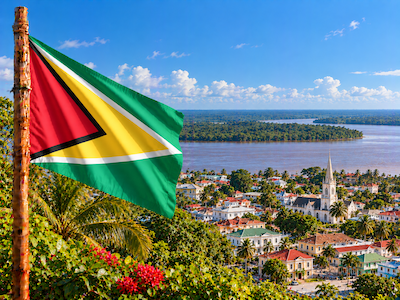
Guyana lies on the northeastern coast of South America, where the Atlantic Ocean meets a vast interior of rainforests, rivers, wetlands, savannas, and coastal plains. Georgetown, the capital, is the country’s main cultural center, known for its wooden colonial architecture, canals, markets, and distinctive Caribbean atmosphere. Guyana’s identity has been shaped by Indigenous peoples as well as centuries of African, Indian, European, and other migration, slavery, and indenture.
Guyana has a rich literary tradition rooted in Indigenous oral storytelling, including myths, legends, chants, prayers, and stories of cultural heroes. These traditions remain an important part of the country’s cultural heritage and exist alongside later African, Indian, European, and Creole influences. Modern Guyanese literature developed largely in English and has often explored colonialism, slavery and indenture, political struggle, race, class, identity, and social inequality. Major writers include Martin Carter, Edgar Mittelholzer, Wilson Harris, Jan Carew, Roy Heath, David Dabydeen, and Fred D’Aguiar. A recurring theme is the tension between belonging and displacement. Guyanese writing frequently moves between the coastal world and the interior, between local traditions and global experience, and between Guyana and its large diaspora. Contemporary literature continues to explore migration, memory, multicultural identity, history, and the lasting effects of colonialism.