Guatemala
North America
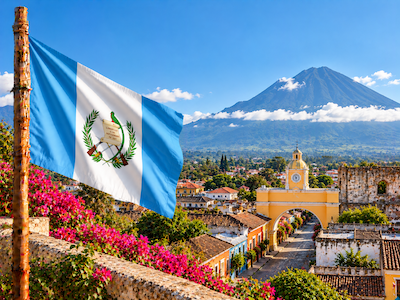
Guatemala is a Central American country of volcanic mountains, highland valleys, tropical forests, lakes, and Caribbean and Pacific lowlands. It has one of the region’s strongest living Indigenous cultural traditions, particularly among Maya communities, alongside Spanish and Afro-Caribbean influences. Cities such as Antigua Guatemala preserve colonial architecture, while places such as Lake Atitlán and the Petén region reflect the country’s extraordinary natural and archaeological heritage.
Guatemala’s literary tradition combines ancient Maya storytelling and mythology with Spanish-language literature. The Popol Vuh, preserved in K’iche’ Maya tradition, is one of the most important surviving Indigenous texts of the Americas, containing creation stories, mythology, genealogy, and reflections on the origins of the Maya people. Modern Guatemalan literature developed through the colonial and postcolonial periods. Miguel Ángel Asturias, awarded the Nobel Prize in Literature in 1967, drew heavily on Maya mythology and explored dictatorship, social inequality, Indigenous life, and political power. His novel Men of Maize is particularly important for its engagement with Indigenous worldview and the conflict between traditional communities and modern economic forces. Other writers such as Augusto Monterroso, Luis Cardoza y Aragón, and Rodrigo Rey Rosa have contributed to Guatemala’s diverse literary landscape. Contemporary writing frequently explores Indigenous identity, colonialism, political violence, migration, memory, inequality, and the relationship between traditional cultures and modern Guatemala.