Spain
Europe
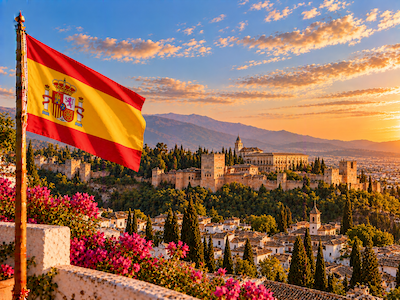
Spain occupies most of the Iberian Peninsula in southwestern Europe, bordered by the Atlantic Ocean and the Mediterranean Sea. Its landscapes range from sunlit Mediterranean beaches and rugged mountains to green northern coastlines, vast central plateaus, and the volcanic Canary Islands. Madrid, the capital, is a major cultural center, while Barcelona, Seville, Granada, and Valencia reflect the country’s diverse architectural and historical heritage. Spanish culture has been shaped by Roman, Visigothic, Islamic, Jewish, and Christian influences, alongside strong regional identities in Catalonia, the Basque Country, Galicia, and other parts of the country.
Spanish literature has a rich history of medieval epic poetry, chivalric romances, religious writing, and oral storytelling. One of its foundational works is The Song of the Cid, an epic poem reflecting medieval ideas of honor and loyalty. During the Golden Age of the 16th and 17th centuries, Spanish literature flourished through drama, poetry, and prose. Miguel de Cervantes’s Don Quixote became one of the most influential works in world literature, exploring the tension between imagination and reality. Other major literary figures include Lope de Vega and Pedro Calderón de la Barca, celebrated for their plays; Federico García Lorca, whose poetry and drama draw on folklore, desire, and social conflict; and Benito Pérez Galdós, known for his realist novels. The 20th century brought writers such as Carmen Laforet, Camilo José Cela, and Carmen Martín Gaite, whose work reflected social change and the legacy of the Spanish Civil War and dictatorship. Contemporary Spanish literature frequently explores memory, identity, family, gender, regional culture, migration, and historical trauma. The country’s literary landscape also includes important traditions in Catalan, Galician, and Basque, offering distinct perspectives within Spain’s multilingual cultural heritage.