Armenia
Asia
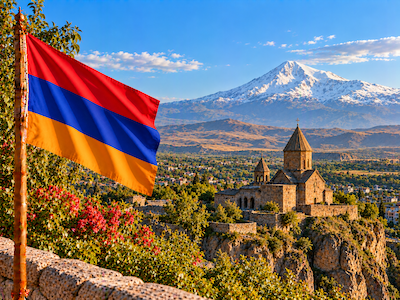


Armenia is a mountainous country in the South Caucasus, situated between Europe and Asia at the crossroads of historic trade and cultural routes. Its landscape is defined by volcanic mountains, deep valleys, high plateaus, and ancient monasteries carved into dramatic stone landscapes. Yerevan, one of the world’s oldest continuously inhabited cities, combines distinctive pink volcanic-stone architecture with a modern urban culture, while Mount Ararat—visible from much of the country despite lying across the modern Turkish border—remains one of the most powerful symbols of Armenian identity. Armenia has a long and complex history shaped by ancient kingdoms, Christianity, Persian and Ottoman rule, Russian influence, and the Soviet period. It was the first state to adopt Christianity as its official religion, traditionally dated to 301 CE, and the Armenian Apostolic Church remains central to the country’s cultural heritage. The Armenian alphabet, created in the early 5th century, also became a major foundation of Armenian literary and cultural identity.
Armenian literature is one of the oldest literary traditions in the region, with a strong connection between language, religion, national identity, memory, and survival. The creation of the Armenian alphabet by Mesrop Mashtots in the early 5th century helped establish a written literary culture, beginning with translations of religious works and the development of original Armenian historical and theological writing. The medieval tradition produced important historians and poets, while later Armenian literature increasingly addressed questions of foreign rule, cultural preservation, displacement, and national identity. Sayat-Nova, an 18th-century poet and musician, became particularly influential for his multilingual poetry, while Hovhannes Tumanyan and Avetik Isahakyan became major figures of modern Armenian literature. The Armenian literary tradition was profoundly shaped by the Armenian Genocide of 1915, which transformed writing about memory, loss, exile, and diaspora. Writers such as William Saroyan, Silva Kaputikian, and Paruyr Sevak explored different aspects of Armenian identity and displacement, while contemporary writers continue to examine the relationship between homeland and diaspora. Modern Armenian literature frequently explores memory, war, migration, family history, cultural survival, and the tension between Armenia and its large diaspora. For readers discovering Armenia, its literature offers a particularly powerful journey through the idea of a nation whose cultural identity has repeatedly survived political upheaval, displacement, and historical rupture.