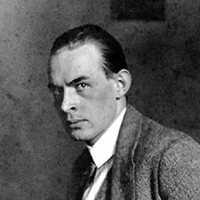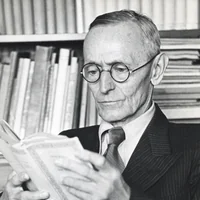
Hermann Hesse
GermanyAbout
German-Swiss novelist and Nobel laureate (1877–1962) whose works explore the spiritual journey of the individual. His novels, deeply influenced by Eastern philosophy and Jungian psychology, enjoyed a massive revival among the counterculture of the 1960s.
Books on TheBookRoads
1

Steppenwolf
Steppenwolf follows Harry Haller, a middle-aged intellectual who feels profoundly alienated from bourgeois society and believes himself divided between two opposing natures: the civilised human being and the solitary wolf. Disillusioned with conventional life, Harry becomes increasingly withdrawn and struggles with thoughts of despair. His encounter with Hermine, a lively and unconventional woman, introduces him to new experiences, including music, dancing, and forms of pleasure he has long rejected. Through these encounters, he begins to question his rigid understanding of identity and the assumption that human beings can be divided into simple opposing parts. Hesse blends psychological exploration with surreal and philosophical episodes to examine loneliness, social conformity, and the possibility of personal transformation. The novel asks whether people can learn to embrace the contradictions within themselves rather than remain imprisoned by a fixed image of who they are.
1927
Germany
2
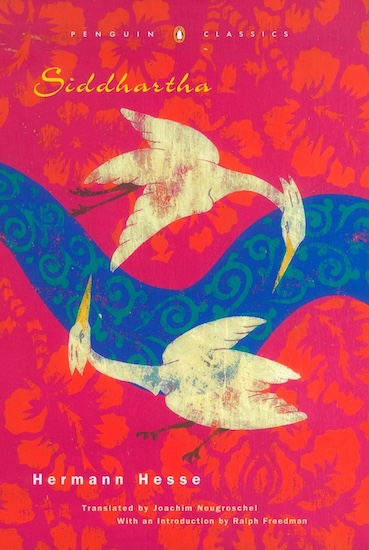
Siddhartha
Siddhartha follows a young man in ancient India who leaves his privileged life in search of spiritual understanding. Dissatisfied with the religious teachings and ascetic practices available to him, Siddhartha travels with his friend Govinda and eventually encounters the Buddha. Although he respects the Buddha’s wisdom, Siddhartha believes that enlightenment cannot simply be learned from another person. He therefore pursues his own experiences, exploring sensual pleasure, wealth, love, and the suffering that accompanies attachment. After years of disillusionment, he finds guidance in the quiet presence of a ferryman and begins to understand the interconnectedness of existence. Hesse draws on Indian religious and philosophical traditions to explore self-discovery, desire, and the limitations of intellectual knowledge. The novel suggests that wisdom emerges not through rigid doctrine but through attentive experience, acceptance, and an understanding of life’s constantly changing nature.
1922
Germany